Why a bed squeaks and what to do about it
A squeak is the sound of friction where something has started to move. Find that spot first, then fix the cause right there.
A bed squeaks when one of its parts has started to move where it should stay still, and rubs against its neighbour. There are several such places: frame joints, slats in their holders, the joints of the lift mechanism, the legs, and sometimes the mattress itself.
There is no universal remedy. What helps the frame won't help the mattress, so find the source of the sound first.
How to find where the sound is coming from
It is easiest with two people: one puts weight on each part of the bed in turn, the other listens.
- —Take the mattress off, lay it on the floor, lie on it and move around. If it squeaks on the floor, the mattress is the cause
- —If the bed has a lift mechanism, do not lower or press on the base without the mattress: read the section on the mechanism below first
- —With the mattress off, press each slat in turn with your palm, close to its ends
- —Rock the bed by the headboard and by the corners: this is how frame joints give themselves away
- —Check that all legs are flat on the floor
- —If the sound only appears when you open the storage box, look in the lift mechanism
After each correction, repeat the same check: this way you can see if the sound has disappeared and if there was another source.
The frame: why bolts keep working loose
Wood shrinks and swells with the humidity of the air, and the bolts and screws in it gradually work loose. Seasonal changes in humidity matter more than daily ones, and varnish or paint only slow the process down. That is why a bed that has been quiet for a long time can start squeaking again when the season changes.
Bed frames are mostly held together by bolts and screws. Tighten them; if a bolt won’t sit tight, add a washer. The same goes for legs screwed to the frame. A removable, medium-strength threadlocker — a liquid that stops a bolt from loosening but still lets you take the joint apart with ordinary tools — only helps where metal goes into metal: a bolt into a nut or a metal insert. It is no good for a screw going into wood.
Pay special attention to the corners: it is the corner joints that take the load when sitting on the bed from the edge.
Slats and holders
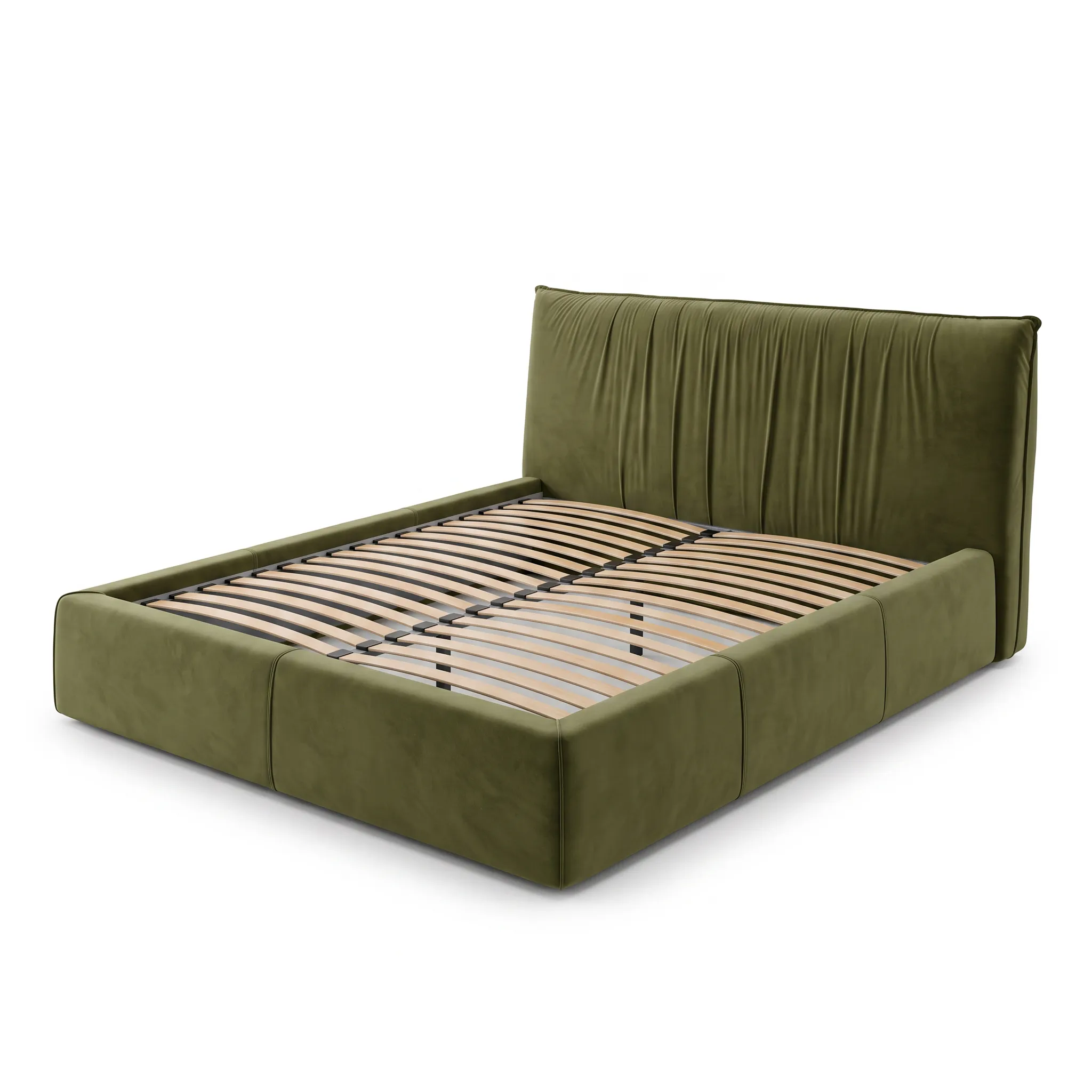
A slat usually sits with its ends in plastic or rubber holders. Over the years plastic holders can turn brittle and rubber ones can harden, and the slat starts to wobble in its socket. Such a holder is easier to replace than to repair. If many holders are worn, replacing the whole base may make more sense.
A cracked slat is replaced with a new one.
There is plenty of advice online on what to lubricate wooden slats and holders with, it contradicts itself, and we found no recommendations from manufacturers. It is more reliable to remove the cause of the friction: replace the worn part.
Beds with a lift mechanism
Two different parts follow two different rules here.
- —The hinges and moving joints of the mechanism are greased with thick grease from time to time and their fixings are tightened — this is what the manual of one bed lift mechanism requires
- —The gas spring is not lubricated at all: gas spring makers say the rod and seals must not be greased and that the spring needs no maintenance
Lift and lower the base by the middle of the crossbar at the foot end. Pulling it by a corner twists the base, and gas springs do not tolerate side loads. The same mechanism manual forbids lowering the base without a mattress. Check the exact requirements in the instructions for your own mechanism.
Legs, floor and mattress
A leg that doesn’t reach the floor makes the frame rock every time you move. Level the bed and put soft pads under the legs.
If the mattress itself creaks, tightening the bolts will not fix it. Spring mattresses creak more often than springless ones.
What to check when choosing a bed
Wooden parts — slats, side rails, frame panels — are found even in beds with a metal frame, and all of them react to humidity. So what matters is how easy it will be to get rid of a squeak if one appears.
- —What holds the frame corners together, and whether you can tighten them yourself
- —How the slats are fixed: in holders that can be replaced when they wear out
Two more points are not about squeaking but about how the base supports the mattress.
- —Centre support: American mattress makers require it for Queen and King beds, that is, from 152 cm wide
- —Slat spacing: mattress makers state the maximum gap in their base requirements, and there is no single norm — the British retailer Dunelm allows up to 7 cm for its mattresses, the American Tempur Sealy up to 10 cm
For some models in our catalogue you choose the base: XL with 4.5 cm between slats (38 slats) or XXL with 2.5 cm (44 slats). In most models the lift mechanism is an option, so you can have the bed with it or without it.